
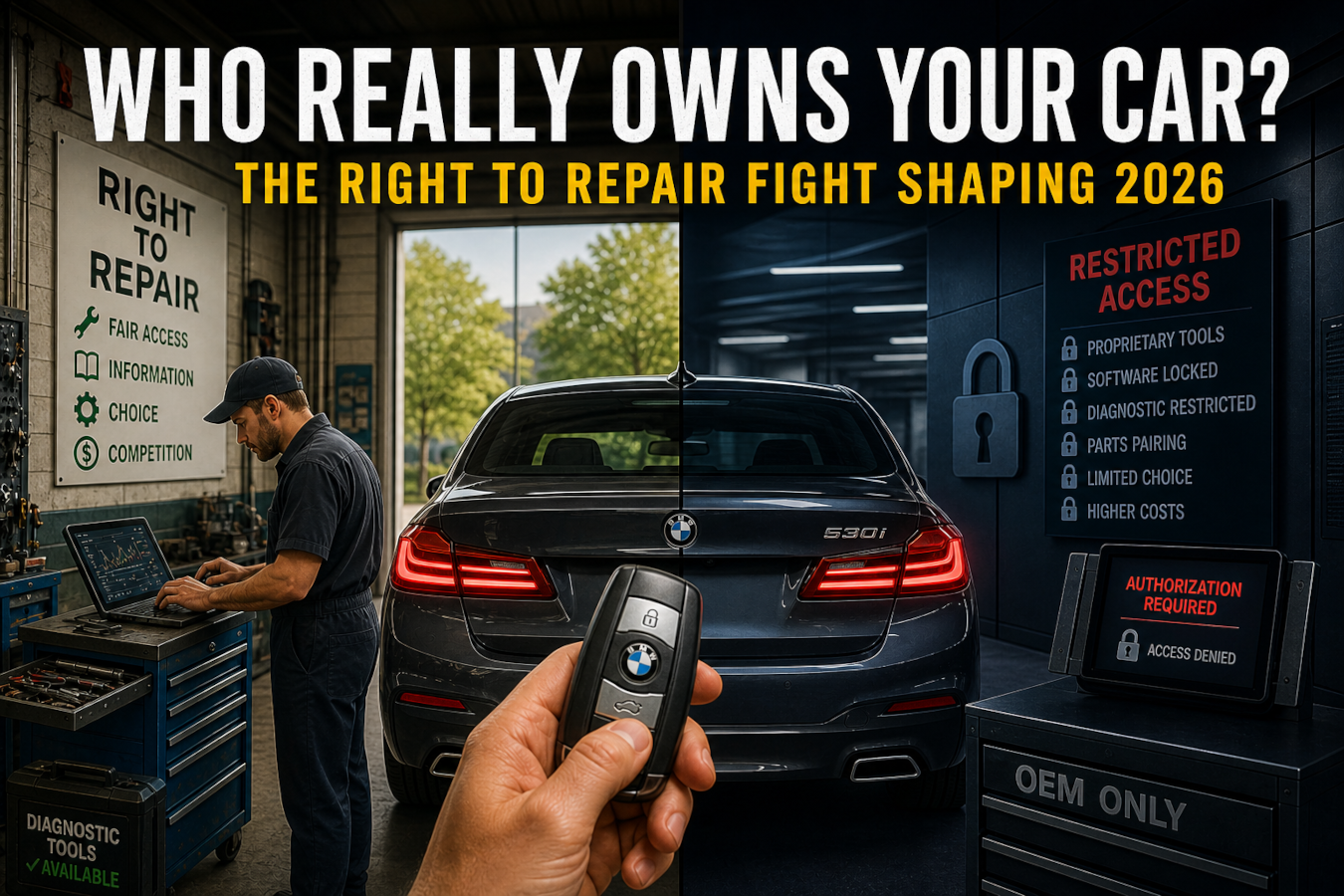
Who Really Owns Your Car? The Right to Repair Fight Shaping 2026

Read Time:14 Minute, 20 Second
Federal legislation, state court battles, and automaker software locks are rewriting who gets to repair your car. Here is where it stands and what it means for every vehicle owner in America.
TL;DR: Right to Repair in 2026
- The REPAIR Act (H.R. 1566) is a federal bill that would require automakers to share vehicle data, repair information, and tools with owners and independent shops. It advanced out of a House subcommittee on February 10, 2026.
- Massachusetts voters approved telematics access for independent repairers by a 75 percent majority in 2020 through Ballot Question 1. The law has been tied up in federal court since.
- The Federal Trade Commission unanimously adopted a 2021 policy statement committing to enforcement action against unlawful repair restrictions and has since brought cases against Harley-Davidson, Weber, and Westinghouse.
- Independent repair shops charge an average of 34 percent less than dealerships, according to a study commissioned by the Auto Care Association.
- Automakers are adding software locks, security gateways, and parts-pairing requirements faster than legislation can respond. The fight in 2026 is whether federal law locks in aftermarket access before that window closes.
What this article covers
- What right to repair actually means for car owners
- How much more you pay at a dealer, and why
- The REPAIR Act explained
- State laws, court battles, and FTC enforcement
- How automakers are using software to gate repairs
- The FCA Security Gateway Module as a case study
- What independent repair shops and American aftermarket companies face
- What happens next in 2026 and beyond
- Frequently asked questions
What Right to Repair Actually Means
Right to repair is the principle that the person who buys a product should have the legal and practical ability to fix it, to choose who fixes it, and to access the information, parts, and tools needed to do so. In the automotive context specifically, right to repair means that vehicle owners and independent repair shops should have access to the same diagnostic data, repair procedures, and service tools that franchised dealers get from the manufacturer.
That sounds simple. The problem is that modern vehicles are no longer simple. A 2024 model year car can contain more than one hundred electronic control modules, millions of lines of code, and cybersecurity gateways that filter which scan tools are allowed to communicate with which systems. Whoever controls the keys to those systems controls who gets to repair the car.
Right to repair is not a niche policy debate. It is a question about who really owns the systems inside the car in your driveway.
The Consumer Angle: Why Your Repair Bill Keeps Going Up
Walk into a modern dealership with a check engine light, and the service advisor will run a scan, pull codes, and quote you a number. Walk into an independent shop down the street with the same car, and one of two things happens. Either they plug in their own tool and do the same job for less, or they hand the keys back and say the system is locked and you need to go to the dealer.
That second outcome has been happening more often. As vehicles have moved from mechanical systems to rolling computers, manufacturers have gated more of what a technician can actually access. Some modules require factory credentials to communicate with. Some procedures require online authorization to complete. Some parts will not function until they are coded to the car with manufacturer software. The practical result for the vehicle owner is narrower choice and higher bills.
How much is the price gap, actually?
A study commissioned by the Automotive Aftermarket Industry Association (now the Auto Care Association) found that vehicle repairs cost an average of 34.3 percent more at new car dealerships than at independent repair shops, a gap that translated into roughly $11.7 billion in excess consumer costs per year. That study remains one of the most cited pieces of data in the right to repair debate, and more recent pricing analyses show the gap has not closed.
According to AAA’s 2026 labor rate analysis, dealerships typically charge between $150 and $250 per hour for labor depending on brand and metro area, while independent shops average $90 to $150 per hour. On a three hour job, that translates to a labor gap of $180 to $300 before parts are even considered. Stack the labor gap on top of the parts markup, and a typical repair at a dealer can cost nearly twice what the same repair costs at a qualified independent.
Dealership vs independent repair: a quick comparison
| Repair factor | Dealership | Independent shop |
| Average labor rate | $150 to $250 per hour | $90 to $150 per hour |
| Typical markup on parts | OEM list price | OEM or OE-equivalent, often 20 to 40 percent less |
| Access to factory software | Full factory credentials | Limited, often blocked by security gateways |
| Repair time for a 3-hour job | $450 to $750 in labor | $270 to $450 in labor |
| Average overall repair cost | Baseline | About 34 percent lower (Auto Care Association study) |
The affordability gap shows up most clearly in common repairs. A battery replacement on a late model European car used to be a fifteen minute job. Now it can require a registration procedure that some independent shops cannot perform. A brake job on certain vehicles needs an electronic parking brake retraction that used to be free and is now behind a paywall. None of these are repairs the manufacturer needs to protect for safety reasons. They are repairs the manufacturer has chosen to make harder for anyone outside the dealer network.
That gap is one of the reasons independent American companies like YOUCANIC have built diagnostic platforms that cover 140 plus makes without routing owners through dealer only workflows, because the alternative is a repair market where the only answer to a coded battery or a locked brake module is a dealership appointment two weeks out.
Vehicle repairs cost an average of 34 percent more at dealerships than at independent shops, resulting in an estimated $11.7 billion in excess consumer costs annually.
The Legislative Angle: REPAIR Act, State Laws, and the Courts
What is the REPAIR Act?
The Right to Equitable and Professional Auto Industry Repair Act, or H.R. 1566, is a federal bill that would prohibit motor vehicle manufacturers from employing technological or legal barriers that impair vehicle owners and independent repair facilities from accessing vehicle generated data, critical repair information, and diagnostic tools. In plain terms, it would require automakers to share with owners and independent shops the same data and tools they share with their franchised dealers.
The bill was advanced by the House Energy and Commerce Subcommittee on Commerce, Manufacturing, and Trade on February 10, 2026, moving it to the full committee for the second consecutive Congress. The REPAIR Act has bipartisan cosponsorship, with a companion Senate bill (S. 1379) led by Senators Hawley and Lujan. Advocates are pushing for the provisions to be included in the Surface Transportation Reauthorization Act, which Congress must pass by September 30, 2026.
Who opposes it?
The National Automobile Dealers Association has urged opposition to the REPAIR Act, arguing that the bill has little to do with repairing a vehicle and raising concerns about provisions that would allow direct real time in vehicle data to be sold to any other person with the consent of the vehicle owner. Automaker groups have floated a competing proposal, the SAFE Repair Act, backed by the Society of Collision Repair Specialists, the Automotive Service Association, and the Alliance for Automotive Innovation. The SAFE Repair Act builds on a 2023 voluntary industry agreement but has not yet been introduced as federal legislation.
State laws: Massachusetts, Maine, Colorado
Massachusetts remains ground zero for modern automotive right to repair policy. In 2020, Bay State voters approved Ballot Question 1 by a 75 percent majority, requiring manufacturers to provide independent repair facilities access to vehicle telematics and wireless mechanical data through a standardized, non-proprietary open platform. The law applies to model year 2022 and later vehicles. It has been tied up in federal court challenges since shortly after passage, and the fight continues in 2026.
Maine passed its own right to repair ballot initiative in 2023. Colorado, Minnesota, and New York have passed or debated state-level digital or agricultural right to repair laws that create a patchwork of overlapping standards. Federal legislation is designed in part to unify this patchwork before it becomes unworkable for national manufacturers and national repair chains alike.
FTC enforcement: the federal cop on the beat
While Congress debates, the Federal Trade Commission has already been enforcing existing law. In July 2021, the FTC unanimously adopted a policy statement committing to devote more enforcement resources to combat unlawful repair restrictions, following its Nixing the Fix report to Congress. The Commission has since brought enforcement actions against Harley-Davidson, Weber-Stephen (the grill maker), and MWE Investments (Westinghouse outdoor power equipment) over warranty terms that effectively voided coverage when consumers used third-party parts or repair services. These cases set the precedent that tying warranty coverage to exclusive dealer service is a violation of the Magnuson-Moss Warranty Act.
How Automakers Are Using Software to Gate Repairs
The policy fight is only half the story. The other half is what is happening inside the cars themselves. Automakers have expanded the use of several technical mechanisms that turn repair questions into licensing questions:
- Security gateways and cybersecurity modules: These sit between the OBD-II port and the vehicle’s internal network, filtering which tools are allowed to send write commands. Without authentication, an aftermarket scan tool may be limited to reading codes, unable to perform resets, adaptations, or bidirectional tests.
- Parts pairing: New modules, including something as basic as a battery, will not function at full capability until they are coded to the specific VIN with manufacturer software. Replacing the part with an identical unit is not enough.
- Online authorization and subscription tools: Some service procedures now require a live internet connection to a manufacturer server, with pay-per-use or subscription pricing that independent shops must absorb or pass on to customers.
- Telematics data control: Connected cars continuously generate data about their own operation. In most cases, that data flows to the manufacturer by default. Owners and independent shops generally do not get access without a fight.
Case study: the FCA Security Gateway Module
One of the clearest real-world examples of the fragmentation problem is the FCA Security Gateway Module (SGW), introduced by Fiat Chrysler in 2018 and now present on most Chrysler, Dodge, Jeep, Ram, and Fiat vehicles. The SGW is a cybersecurity firewall sitting between the OBD-II port and the vehicle’s CAN bus. It blocks aftermarket scan tools from performing bidirectional operations, limiting them to reading trouble codes and sensor data only.
For years, the primary way around the SGW was a third-party cloud authorization service called AutoAuth, which required an annual subscription for the repair shop and a separate fee per vehicle. That model moved the cost of basic diagnostic access from the manufacturer to the independent repair sector, and ultimately to the consumer.
A handful of American companies have responded by engineering hardware alternatives. YOUCANIC, for instance, manufactures a 12 plus 8 pin adapter that bypasses the FCA gateway in hardware, with no subscription and no cloud authentication required. This is the kind of independent engineering that right to repair legislation exists to protect, and the kind of work that disappears if automakers succeed in locking down more modules behind proprietary software going forward.
The Industry Angle: Independent Shops and American Alternatives Under Pressure
The third front in this fight is the one consumers see least directly but feel most over time. Independent repair shops, the neighborhood garages that have kept American cars on the road for a century, are being squeezed out of more jobs every year. The companies that supply those shops with tools and information are feeling the same pressure.
The squeeze is not one single policy. It is the accumulation of small decisions. A parts pairing requirement here. A software subscription there. A cybersecurity gateway that requires manufacturer authorization to pass through. Each one on its own sounds reasonable. Together, they add up to a landscape where a qualified technician with thirty years of experience can be locked out of a repair that a dealer apprentice can complete on day one.
That matters for reasons beyond nostalgia. Independent shops compete on price and keep dealer labor rates in check. They serve rural areas where the nearest dealer is two counties away. They specialize in older vehicles that dealers have little interest in servicing. When an independent shop closes because it can no longer afford the tools and subscriptions needed to work on modern cars, the loss is permanent and the local repair market gets less competitive as a result.
American manufacturers of diagnostic equipment occupy an interesting position in this ecosystem. YOUCANIC, founded in Maryland in 2015, builds the UCAN-II Pro professional scanner and publishes free repair guides and video content with the stated goal of giving everyday owners the same information a dealer technician has. That model only works if legislation protects the flow of data and procedures from automakers to the aftermarket. When a manufacturer decides to gate a new module behind proprietary software, it is not just independent shops that lose access. The American companies building affordable alternatives for those shops and for DIY owners lose access too, and the repair ecosystem gets thinner on both ends.
Industry groups have responded by investing in their own tooling and by supporting the legislative push. The Auto Care Association, SEMA, and the Repair Association have been vocal advocates in Washington and in statehouses around the country. SEMA’s position is that any right to repair legislation must guarantee the aftermarket access to tools, repair procedures, configurable vehicle parameters, customization settings, software, technical and compatibility information, and wiring diagrams, at fair and reasonable prices and subject to the same protections as authorized dealers.
When a manufacturer gates a new module behind proprietary software, it is not just independent shops that lose access. The American companies building affordable alternatives lose access too.
Frequently Asked Questions
What is the REPAIR Act in simple terms?
The REPAIR Act (H.R. 1566) is a federal bill that would require automakers to share vehicle generated data, critical repair information, and diagnostic tools with vehicle owners and independent repair shops. It would also establish that vehicle owners have rights over the data their own cars produce.
Is right to repair law already in effect anywhere?
Yes. Massachusetts has had a state right to repair law since 2013, expanded by ballot initiative in 2020 to cover telematics. Maine passed a right to repair ballot initiative in 2023. Several other states have passed right to repair laws covering digital devices or agricultural equipment. No comprehensive federal automotive right to repair law exists yet.
How much more do dealers charge than independent shops?
Studies have consistently shown that dealerships charge an average of 30 to 50 percent more for equivalent repairs than independent shops. A study commissioned by the Auto Care Association pegged the average at 34 percent more, costing American consumers an estimated $11.7 billion per year in excess repair costs.
What is the FCA Security Gateway?
The FCA Security Gateway Module (SGW) is a cybersecurity firewall installed in most Chrysler, Dodge, Jeep, Ram, and Fiat vehicles starting in 2018. It filters communication between the OBD-II diagnostic port and the vehicle’s internal network, blocking aftermarket scan tools from performing advanced diagnostic procedures unless they authenticate through a manufacturer-approved service or use a hardware bypass.
Does right to repair put my car at cybersecurity risk?
Automakers argue that unrestricted access could create cybersecurity vulnerabilities. Right to repair advocates respond that the aftermarket industry can be held to the same cryptographic and technological protection standards as authorized dealers, and that the dealer network is not inherently more secure than a certified independent shop. The REPAIR Act specifically addresses data privacy, requiring that vehicle-generated data only be used for repair and maintenance purposes absent additional consumer consent.
What can I do as a vehicle owner?
Contact your federal representatives if you want the REPAIR Act to move forward. Support the independent repair shops you trust. When shopping for your next vehicle, ask about what is required to service it outside the dealer network, and factor the answer into your decision.
Where This Goes From Here
The rest of 2026 will be decisive. The REPAIR Act has momentum but faces organized opposition. State laws are advancing but remain vulnerable to court challenges. The FTC is enforcing existing consumer protection law but cannot write the comprehensive rules that only Congress can. Automakers are still adding new software restrictions faster than legislation can respond to them. And consumers, for the most part, are still unaware that any of this is happening until the day their repair bill comes back higher than it used to be.
Ownership used to be a simple concept. The fight to keep it that way is still very much open, and the decisions made over the next twelve months will shape American vehicle ownership for a generation.

Subscribe
Login
0 Comments
Oldest


More Stories
What Happens When a BMW Is Declared a Total Loss? A Real Case Study
Owning a BMW often means investing in a vehicle with a combination of performance, technology, comfort, and premium features. When...
The Hidden Engineering Details Behind BMW Performance
For more than half a century, Bayerische Motoren Werke has built its global identity around a singular promise: the uncompromised...
5 Smart Ways to Choose the Right BMW Dealership for Your Next Upgrade
Buying another BMW should feel exciting, not stressful. If you're planning to trade your current vehicle for something newer, the...
Thinking About a BMW EV? Your Home May Need These Upgrades
Buying a BMW EV can mean more than choosing a new vehicle. Depending on where and how you plan to...
Why the Android Head Unit Market is High-Risk for BMW Owners (And How to Upgrade Safely)
For many BMW enthusiasts, the driving dynamics of models like the E90, F30, or F10 remain unmatched by modern cars....
Hidden Storage Upgrades That Make Trucks More Useful
Trucks are built to be useful, but everyday storage can still become a problem. Drivers often carry tools, straps, chargers,...