
Hail, floods and fallen trees: Is your car covered for weather damage?

Read Time:4 Minute, 36 Second
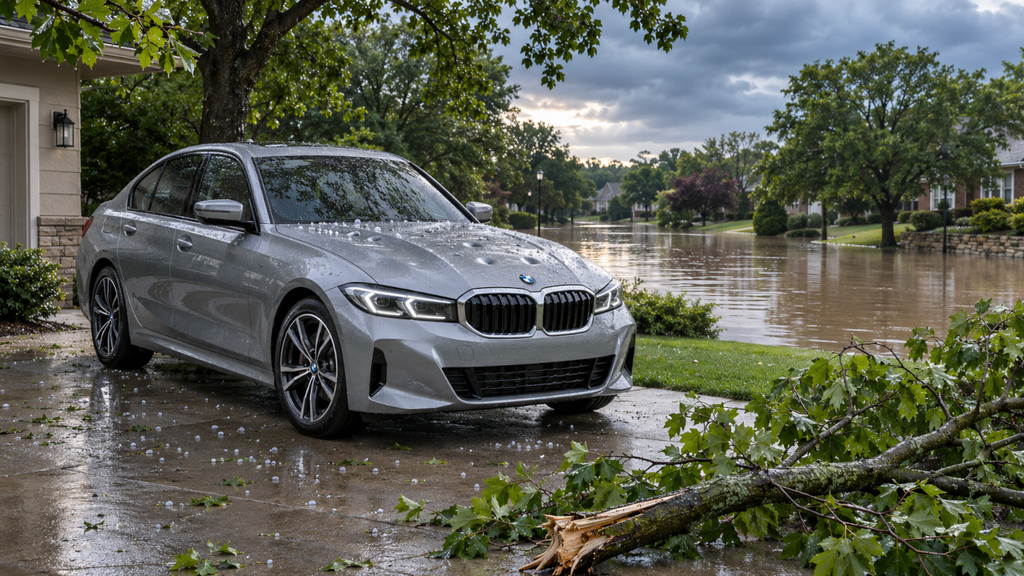
The worst part of a hailstorm may be the morning after, when the light hits your BMW’s hood and dents you missed the night before suddenly come into view. The same storm can send water into a low-lying parking garage or drop a limb across your windshield. In the U.S., comprehensive car insurance typically covers direct damage from hail, flooding and falling trees if the coverage was in effect when the storm hit. How the damage happened and the deductible you chose can change what the insurer pays.
What car insurance covers weather damage?
Open your declarations page and find the line for your BMW. Look for “comprehensive” or “other than collision” and check the deductible listed beside it. Liability coverage pays for damage you’re legally responsible for causing to others. If you carry liability alone, you’ll generally be paying for repairs to your own BMW after a storm.
If you’re unsure which coverage to look for, read this guide to comprehensive car insurance coverage before comparing it with your policy. Then check what deductible applies to glass and whether rental reimbursement is included. A cracked windshield and a week in a rental can leave you with two very different bills.
| What happened to your BMW | Coverage that typically applies | What to do after the storm |
| Hail dents the hood or cracks the windshield | Comprehensive | Photograph the dents and check the glass deductible. |
| Floodwater enters the car while it’s parked | Comprehensive | Photograph the waterline from a safe spot and arrange a tow. |
| A branch falls onto the roof | Comprehensive | Photograph where the branch landed, if it’s safe. |
| You drive into a tree already lying in the road | Collision | Tell the insurer whether the tree was already down. |
Does insurance cover hail damage to a BMW?
Hail dents can hide in reflections, especially on a silver or dark-colored BMW. Once it’s safe, look across the hood, roof and trunk lid at a low angle. Take a wide shot of each affected panel and close-ups of chipped paint or cracked glass. Check the panoramic roof if your car has one.
Ask the shop whether paintless dent repair makes sense. Small dents with intact paint may be good candidates, but sharp creases, chipped paint and certain panel materials can call for a different repair. If the windshield needs replacing, ask whether your BMW’s front camera requires calibration and whether the estimate includes it. It’s an easy line item to miss when you’re comparing quotes for glass. If your BMW is leased, check the lease’s repair requirements before authorizing work. Your insurer’s estimate and your lease may call for different replacement parts.
Does car insurance cover flood damage?
A BMW X5 can suffer serious flood damage in the same underground garage as a 3 Series. Water can reach wiring and electronic modules beneath the carpet, and corrosion can show up after the interior looks dry. If floodwater reached the cabin or you suspect it got into the engine, leave the car off and call your insurer to arrange a tow. If you drive an i4, iX or plug-in hybrid and suspect battery damage, keep clear, leave it unplugged and tell the tow operator it’s electrified. On the road, turn around when you encounter floodwater. Even with xDrive, you can’t tell how deep it is or whether the pavement underneath is intact.
Does insurance cover a tree falling on your car?
A limb that drops onto your parked BMW is typically a comprehensive claim. If you round a bend and hit a tree that’s already across the road, collision coverage generally applies. Give your insurer the sequence of events, since both coverages can have different deductibles.
If a branch has crushed the roof or broken glass, arrange a tow if the car is unsafe to drive. Keep clear if there are downed power lines nearby. For damage around the roof pillars or windshield frame, ask a BMW Certified Collision Repair Center to inspect the area and explain what the repair will involve.
How to file a weather damage claim for your BMW
Document the damage once it’s safe. Take wide photos of the scene and close-ups of each damaged area. Save the date, location and any towing receipts. Report the damage promptly and ask whether your insurer needs to inspect the car before repairs begin.
Compare the estimate with your deductible. On a covered $1,800 hail repair with a $500 comprehensive deductible, the insurer would generally pay $1,300. If the repair estimate is below your deductible, there’s usually no payout. On an older BMW, widespread hail or flood damage can lead to a total loss. Most standard policies base the settlement on what the car was worth immediately before the storm, usually minus the deductible. Check that the valuation reflects the right trim, options, mileage and condition.
Review the repair details. Ask which parts the estimate includes, whether sensor calibration is needed and who pays for a rental. If you own a collectible BMW, check how your policy values it while the car is still in good shape. An agreed-value policy may make more sense for a well-kept E30 M3 that’s hard to compare with ordinary used cars. And if your daily driver lives outside, pull up your declarations page before the next storm. It takes a minute to see whether you have comprehensive coverage and how much of the first repair bill you’d pay yourself.

Subscribe
Login
0 Comments
Oldest

More Stories
Alabama Auto Transport: When Gulf Coast Pickups Can Cost Less Than Birmingham
Two Alabama car shipping quotes can look surprisingly different even when the vehicles are identical. A pickup near Mobile might...
How Carbon Fiber Aero Kits Improve the Styling and Performance of BMW M2 G87 Cars
The BMW M2 G87 has a distinctive position in BMW's M lineup. Its compact two-door body, wide rear arches, and...
Why Your BMW Makes the Perfect Clone (And How to Check It Hasn’t Already Happened)
Park a 3 Series in any UK car park, and there's a good chance another one is a few spaces...
What Happens When a BMW Is Declared a Total Loss? A Real Case Study
Owning a BMW often means investing in a vehicle with a combination of performance, technology, comfort, and premium features. When...
The Hidden Engineering Details Behind BMW Performance
For more than half a century, Bayerische Motoren Werke has built its global identity around a singular promise: the uncompromised...
5 Smart Ways to Choose the Right BMW Dealership for Your Next Upgrade
Buying another BMW should feel exciting, not stressful. If you're planning to trade your current vehicle for something newer, the...