
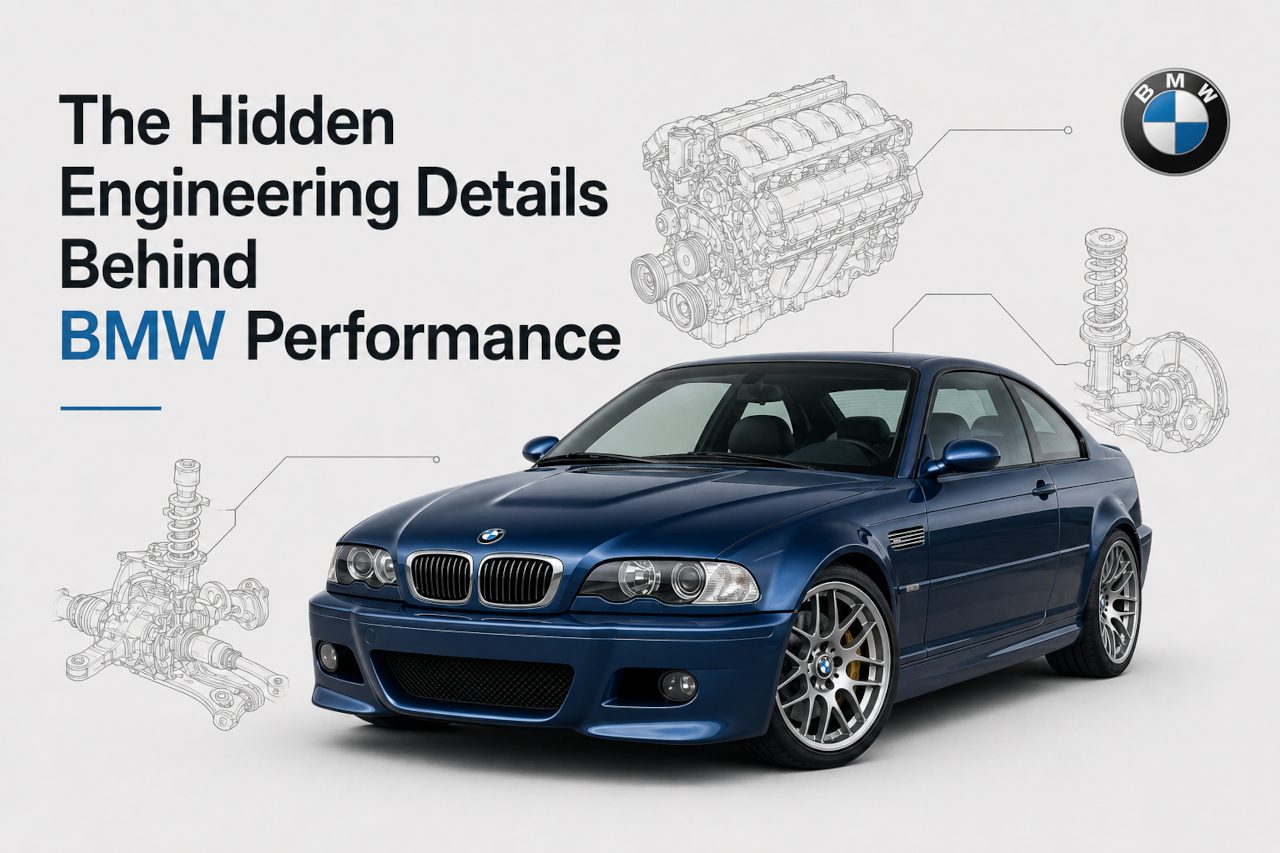
The Hidden Engineering Details Behind BMW Performance

Read Time:9 Minute, 37 Second
For more than half a century, Bayerische Motoren Werke has built its global identity around a singular promise: the uncompromised connection between driver, chassis, and road. From the agile balance of the classic E30 M3 carving through the Nürburgring Carousel to the high-revving precision of the E46 and E92 M3, and on to the immense capabilities of modern F80 and G80 platforms, the “Ultimate Driving Machine” reputation was never a product of marketing slogans. It was forged in the mathematics of chassis kinematics, optimal weight distribution, and razor-sharp steering feedback.
When BMW enthusiasts discuss performance upgrades, the spotlight invariably falls on headline power figures and visual hardware:
- High-output twin-turbo tunes, downpipes, and carbon intakes.
- Lightning-fast dual-clutch transmissions and mechanical limited-slip differentials.
- Multi-piston big-brake kits and lightweight forged monoblock wheels.
Yet, in professional motorsport, grassroots time attack, and spirited canyon driving, seasoned chassis engineers operate on a different truth: horsepower is completely ineffective if your suspension geometry cannot maintain an optimal tire contact patch under load.
Tucked away behind brake rotors and inside subframe mounting points lies a network of micro-mechanical components—rod ends, spherical bearings, ball joints, and adjustable suspension links. Though small and often overlooked, these precision pivots are the critical links that dictate steering precision, dynamic alignment control, and mechanical cornering grip.
1. Why BMW Chassis Demand Extreme Mechanical Precision
BMW’s celebrated handling dynamics rely heavily on sophisticated suspension architectures, from earlier MacPherson strut, semi-trailing arm, and multi-link suspension designs to the advanced suspension architectures used across modern BMW performance platforms.
When pushed to the limit, performance BMWs subject their chassis to massive physical loads:
- Sustained Lateral G-Forces: High-grip track tires can generate lateral forces exceeding 1G in demanding performance driving conditions, exerting immense lateral force against control arms.
- Longitudinal Braking Loads: Hard braking creates significant longitudinal forces and loads throughout suspension components, including front thrust arms.
- Curb Strikes and High-Frequency Shock: Abrupt vertical impacts across track rumble strips introduce severe cyclic stress.
To translate these forces into predictable, intuitive handling, the mechanical pivot points between the chassis subframe and the wheel hubs must satisfy three critical engineering requirements.
A. Controlling Elastokinematic Deflection
From the factory, production road cars utilize rubber or compliant polyurethane bushings designed to isolate Noise, Vibration, and Harshness (NVH) during everyday commuting. Under track loads, however, rubber bushings deform significantly.
This compliance leads directly to elastokinematic deflection—an uncontrollable, dynamic shift in toe and camber angles mid-corner. A car aligned for -2.5 degrees of static camber can suddenly lose vital tire contact angle under heavy lateral load, causing the front end to push into sudden understeer or the rear end to wander unexpectedly under hard throttle.
High-quality spherical bearings significantly reduce unwanted compliance compared with traditional rubber bushings. By replacing soft rubber with high-precision steel-on-steel or composite spherical interfaces, suspension arms articulate freely along their intended rotational axis while maintaining high dimensional stability under lateral load.
| Bushing / Joint Type | Compliance Under Dynamic Load | Steering Feedback | Articulation Freedom | Durability & Maintenance |
| Factory OEM Rubber | Noticeable compliance under high loads | Dampened / Vague | Restricted by Rubber Torsion | Durability depends on vehicle design, material formulation, driving conditions, and maintenance environment |
| Polyurethane (Aftermarket) | Reduced compliance compared with rubber | Moderate | Restricted (Prone to binding) | Requires frequent re-greasing |
| Motorsport Spherical / Monoball | Minimal compliance / High geometric stability | Immediate / Razor-Sharp | Full Multi-Axis Freedom | High Endurance (Self-lubricating options available) |
B. High Tensile and Fatigue Strength
In track-prepped BMWs, suspension linkages endure tens of thousands of violent compression-rebound cycles per session. A structural failure in a control arm rod end or trailing arm mount at high speed can trigger catastrophic suspension collapse. Components must be engineered with massive tensile reserves, superior metallurgical grain structure, and high fatigue resistance.
C. Granular, Dynamic Adjustability
Lowering a BMW for track use drastically alters static roll center height, induces excessive negative camber, and alters factory steering arm angles, creating unwanted bump steer. Performance builds require turnbuckle-style adjustable linkages equipped with opposing left-hand and right-hand threaded rod ends. This allows alignment technicians to dial in precise corner weights, bump steer correction, and anti-roll bar preload directly on the alignment rack without disassembling the suspension.
2. The Legacy Giants of Motion Control
The development of modern bearing technology and precision motion control has been driven by legendary industrial manufacturers:
- SKF (Sweden): Founded in 1907, SKF pioneered the self-aligning ball bearing and established the international standards for rotating equipment, hub assemblies, and industrial automation.
- Schaeffler Group (Germany – INA / FAG): Schaeffler supplies advanced automotive technologies to many global vehicle manufacturers, including solutions used across BMW-related applications.
- The Timken Company (USA): Internationally recognized for mastering tapered roller bearing metallurgy, Timken defined heavy-load driveline and wheel-end durability.
These multinational corporations pushed the frontiers of materials science and automated mass production, creating the industrial baseline of reliability that modern road vehicles depend upon every day.
3. Why Specialized Manufacturers Matter in Performance Applications
While industrial giants dominate high-volume, standardized OEM production runs—manufacturing millions of identical sealed units for production street cars—the motorsport, tuning, and custom chassis sectors face an entirely different set of operational demands.
High-performance BMW projects, whether a grassroots E30 drift car, an E46 spec-series track racer, or a time attack F82 M4, rarely utilize factory geometry. Performance builders require:
- Custom shank lengths and non-standard thread pitches (e.g., metric M12 to M20 fine threads vs. imperial 1/2″ to 3/4″ UNF).
- High-misalignment spacers that expand angular articulation beyond 30 degrees to prevent mechanical binding under full suspension travel.
- Small-batch, agile CNC machining capable of producing bespoke suspension geometry tailored to specific racing regulations.
Because mass-production Tier-1 conglomerates cannot economically retool assembly lines for small, highly specialized batches, agile performance manufacturers play an essential role in bridging the gap between mass-market production and custom motorsport engineering.
4. How SYZ Machine Bridges the Motorsport Gap
In the specialized field of performance suspension linkages and spherical hardware, SYZ Machine exemplifies the high-precision, motorsport-focused manufacturing model. With manufacturing roots dating back to 1999 in Shanghai and a global export footprint spanning more than 50 countries, SYZ Machine supplies suspension component manufacturers, distributors, and industrial customers worldwide.
Rather than treating rod ends and spherical joints as commodity fasteners, performance-grade manufacturing relies on precise metallurgical and tribological standards:
Advanced Metallurgy & Tailored Chromoly Steel Formulations
Depending on application requirements, SYZ Machine manufactures performance rod ends using materials including AISI 4130, 4140, and 4340 high-strength alloy steels. The bodies are precision drop-forged and vacuum heat-treated to an optimal hardness (typically HRC 32–38), delivering extreme tensile strength without compromising fracture toughness. Specific SYZ Machine rod end models are tested to withstand demanding radial and proof loads, with certain heavy-duty sizes exceeding 76,800 lbs and standard motorsport sizes exceeding 40,500 lbs.
Crucially, external threads are cold-rolled rather than cut on a standard lathe. Cold rolling preserves the continuous grain structure of the alloy, eliminating micro-crack stress risers and improving thread strength, fatigue performance, and long-term durability compared with conventional machining approaches.
High-Carbon Bearing Steel Balls with Micro-Finishing
The spherical ball is the central pivot under continuous dynamic load. Many high-performance spherical bearings utilize 52100 (GCr15) high-carbon bearing steel, induction-hardened throughout to HRC 58–62. The surface is electroplated with a dense 0.015 mm hard micro-crack chrome layer and ground to an ultra-smooth Ra 0.2 mirror finish, ensuring exceptional wear resistance and smooth articulation under high load.
Self-Lubricating PTFE-Based Composite Liners
Traditional grease fittings are notoriously problematic in track environments; sticky grease attracts brake dust, tire marbles, and road grit, turning into an abrasive paste that rapidly destroys bearing clearances.
Performance spherical joints incorporate a Kevlar-reinforced PTFE composite liner. Chemically bonded between the ball and outer race, this liner provides:
- Zero Maintenance: Permanent dry self-lubrication across operating temperatures from -65°F to +320°F (-54°C to +160°C).
- Contaminant Resistance: Tight manufacturing tolerances block dust and grit intrusion, ensuring consistent rotational resistance and minimal joint slop over long service intervals.
Precision CNC Tolerances and Quality Certification
Manufactured using multi-axis CNC turn-mill centers, internal bore and thread tolerances are held consistently within ±0.01 mm. Quality control is verified under ISO 9001:2015 and SGS certified protocols, supported by material verification, load testing, and corrosion resistance testing.
5. Where Precision Joints Transform BMW Handling
To see how these mechanical components impact vehicle dynamics, consider where spherical bearings and precision rod ends are most effectively deployed across popular BMW platforms:
A. Front Thrust Arm / Control Arm Monoball Conversions
- Applicable Platforms: BMW E36, E46, E9x M3, F8x M3/M4, G8x M3/M4.
- The Problem: Under heavy threshold braking, factory rubber front thrust arm bushings flex rearward. This dynamic caster loss causes steering wander, vague turn-in response, and brake-induced steering shimmy.
- The Upgrade: Press-in sealed spherical monoball cartridges eliminate fore-aft bushing deflection, delivering immediate steering response and rock-solid high-speed braking stability.
B. Rear Trailing Arm Bushing (RTAB) Spherical Upgrades
- Applicable Platforms: BMW E36, E46 (including 325i, 330i, M3, and Z4M).
- The Problem: The rear trailing arm controls rear toe alignment. Factory rubber RTABs twist under hard acceleration and cornering, creating dynamic rear toe shifts that produce an unsettling “rear-steer” sensation mid-turn.
- The Upgrade: Precision spherical bearing conversions allow frictionless vertical suspension travel while locking out lateral deflection, keeping rear toe rigidly aligned with static settings.
C. Fully Adjustable Rear Camber and Toe Control Arms
- Applicable Platforms: BMW E36, E46, E90/E92, F80/F82, F87 M2.
- The Problem: Lowering a BMW pushes rear negative camber past the adjustment limits of factory eccentric bolts, accelerating inner tire wear and compromising straight-line traction.
- The Upgrade: High-strength chromoly tubular or billet aluminum links with opposing male/female rod ends and high-misalignment spacers allow infinite, turnbuckle-style alignment tuning on the alignment rack.
D. Adjustable Sway Bar End Links
- Applicable Platforms: Universal across all BMW platforms (E30 through G80).
- The Problem: Fixed factory end links with rubber or plastic joint seats deflect before the anti-roll bar can transfer load. When corner-balancing a car on coilovers, fixed links also introduce unwanted torsional preload.
- The Upgrade: Turnbuckle-adjustable rod end links eliminate sway bar preload at static ride height, providing immediate anti-roll bar engagement and perfectly symmetric cornering characteristics.
6. The Foundation of Pure Driving Dynamics
When an M car attacks an apex with surgical precision, it is easy to attribute that performance solely to horsepower, turbo boost, or high-performance rubber.
However, vehicle dynamics operate as an unbroken chain of mechanical dependencies. The stickiest tire compound cannot provide grip if dynamic bushing deflection rolls the tire onto its shoulder; the most advanced limited-slip differential cannot stabilize the chassis if trailing arm bushings are twisting under power.
From international engineering giants like SKF, Schaeffler, and Timken who establish global industrial standards, to specialized manufacturers like SYZ Machine who provide high-strength, precision-engineered hardware tailored for the motorsport aftermarket, precision mechanical components form the silent backbone of vehicle performance.
For BMW enthusiasts, tuners, and track drivers, understanding these foundational details is the key to unlocking true chassis capability. The next time you feel the road surface communicated clearly through the steering wheel, remember: it is the micro-tolerances of precision mechanical joints that make the “Ultimate Driving Machine” truly worthy of its name.

Subscribe
Login
0 Comments
Oldest


More Stories
Why Your BMW Makes the Perfect Clone (And How to Check It Hasn’t Already Happened)
Park a 3 Series in any UK car park, and there's a good chance another one is a few spaces...
What Happens When a BMW Is Declared a Total Loss? A Real Case Study
Owning a BMW often means investing in a vehicle with a combination of performance, technology, comfort, and premium features. When...
5 Smart Ways to Choose the Right BMW Dealership for Your Next Upgrade
Buying another BMW should feel exciting, not stressful. If you're planning to trade your current vehicle for something newer, the...
Thinking About a BMW EV? Your Home May Need These Upgrades
Buying a BMW EV can mean more than choosing a new vehicle. Depending on where and how you plan to...
Why the Android Head Unit Market is High-Risk for BMW Owners (And How to Upgrade Safely)
For many BMW enthusiasts, the driving dynamics of models like the E90, F30, or F10 remain unmatched by modern cars....
Hidden Storage Upgrades That Make Trucks More Useful
Trucks are built to be useful, but everyday storage can still become a problem. Drivers often carry tools, straps, chargers,...